More than a sea between continents
The Mediterranean is far more than a stretch of water between continents. It is a living space shaped by ecosystems, civilisations, trade routes and cultural exchanges that have evolved over millennia.
It covers less than 1% of the global ocean surface, yet it hosts approximately 18% of all known marine species, making it one of the richest reservoirs of marine biodiversity on Earth. At the same time, it borders densely populated coastlines and remains one of the world’s leading tourist destinations.
Yet this unique semi-enclosed sea has become one of the world’s main hotspots of environmental change. Climate change, pollution, overexploitation of marine resources, habitat degradation and the spread of non-native species are no longer isolated pressures. They interact, reinforce one another and accelerate transformations already under way. The Mediterranean is warming faster than the global ocean average, acidifying, accumulating plastics and contaminants, and gradually losing the ecosystems that have long defined its ecological identity.
A new publication by MedECC and Plan Bleu
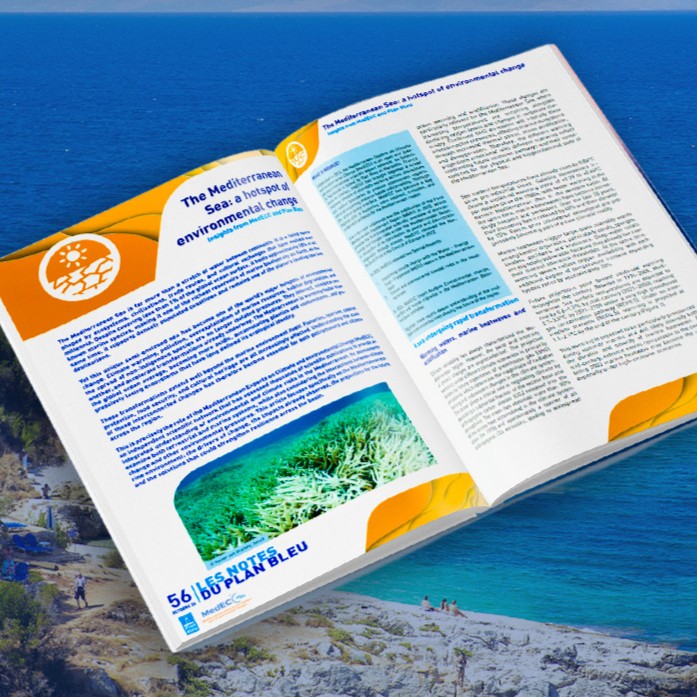
In a new publication co-authored by the Mediterranean Experts on Climate and environmental Change (MedECC) and Plan Bleu, we take stock of the environmental changes affecting the Mediterranean marine environment, their impacts on ecosystems and societies, and the solutions needed to strengthen its resilience.
Three key findings
1. A rapidly warming Mediterranean Sea
Mediterranean sea surface temperatures have been rising by 0.29 to 0.44°C per decade since the 1980s. Over the past 20 years, the frequency of marine heatwaves has increased by 40% and their duration by 15%. These extreme events have triggered mass mortality among sensitive marine species, including corals.
2. Marine biodiversity under pressure
Since 1950, the Mediterranean has lost 41% of its marine species at the top of the food chain, due to climate change and overfishing. Today, 32% of Mediterranean marine habitats are threatened. Posidonia seagrass meadows, essential to the health of the basin, are declining by 1.2 to 5% every year.
3. Increasingly vulnerable coastlines
Under very high greenhouse gas emission scenarios, sea level could rise by 0.63 to 1.01 metres by 2100. Nearly 20 million people live less than 5 metres above sea level in the Mediterranean coastal belt. Meanwhile, if current trends continue, plastic leakage into the Mediterranean could double by 2040.
Solutions exist
Protecting the Mediterranean is still possible. The publication highlights several essential steps:
- Expanding Marine Protected Areas to safeguard critical habitats and species
- Restoring degraded ecosystems, including seagrass meadows
- Promoting sustainable fisheries management to rebuild marine life
- Preventing pollution at its source, notably plastics
Discover the full publication and explore the scientific insights provided by MedECC: