Executive Summary
Human migration1 has today assumed spatial and temporal scales of exceptional magnitude. It involves conflict– and disaster-induced displacement of individuals and communities. The term ‘disaster-induced displacement’ does not only refer to displacement due to natural events, such as natural hazards, extreme weather events, or climate-related impacts, but may also include socio-economic hardships, human disturbances and political pressures. {1.1}2
While shaped by a number of generic key aspects that are valid in other contexts worldwide, the Mediterranean region deserves special attention when considering the environmental change3-conflict-migration nexus because of its climatic, economic and societal setting (medium confidence)4. {1.2}
Abandoning their original settlements because of the severe consequences of environmental change may be seen as a frequently applied adaptation strategy for affected communities (medium confidence). It is critically important to consider that voluntary or involuntary migration is usually the result of a variety of drivers. Contrary to commonly quoted convictions, environmental change represents just one factor among others in the decision to migrate. Other drivers, particularly conflicts and their devastating consequences, various general socio-economic factors, as well as governance issues in a given country, frequently constitute more important drivers of migration than environmental change and its impacts. The number of conflict-induced displacements in 2021 was the highest ever recorded with 14.4 million migrants worldwide (high confidence). {1.3}
The southern and eastern Mediterranean countries and the Arab region are particularly relevant cases for conflict-induced displacement because they are affected by complex and violent armed struggles (medium confidence; Section 1.2.3). The impacts of environmental change may lead to enhanced competition over scarce resources and exacerbate conflicts and migration (medium confidence; Section 1.2.3). Environmental change may also aggravate structural inequalities between southern and eastern Mediterranean countries, on the one hand, and northern Mediterranean countries and Europe, on the other (medium confidence). {1.2.3}
This Analysis comprises seven chapters. An important aspect of the science-policy context of this Analysis is a well-organised Science-Policy Interface (SPI) for the Mediterranean described in a dedicated Box.{1.2.1; 1.2.2; Box 1.1}
The drafting of this Analysis follows the practices and processes established by the Mediterranean Experts on Climate and environmental Change (MedECC) network in the context of the First Mediterranean Assessment Report (MAR1) (MedECC 2020). Preparation of the report involved contributions from 39 authors representing 21 countries. {1.4; Annex 1}
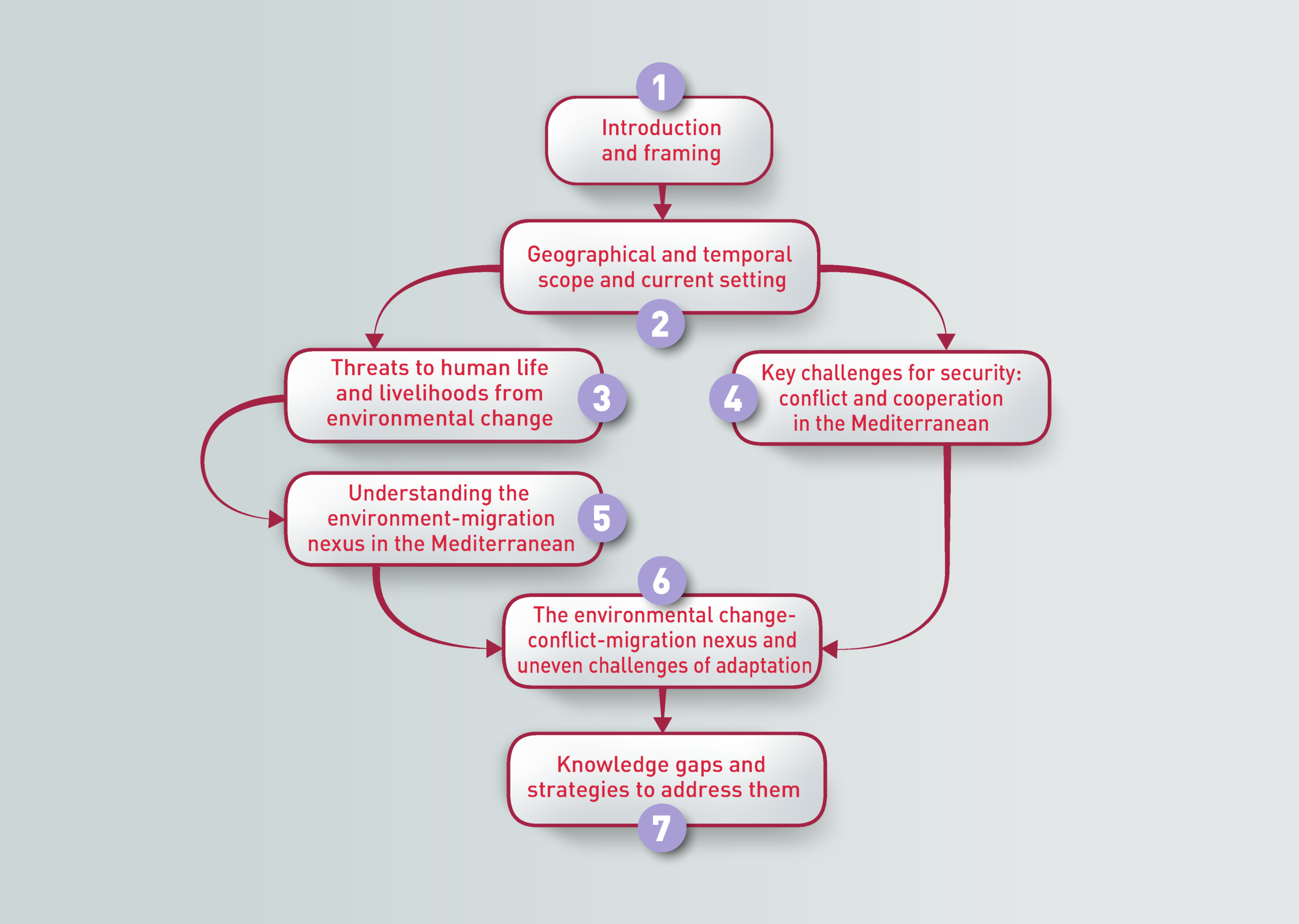
A brief description of the report’s structure and the main issues covered. Numbers in the figure denote chapter numbers.
1 - In this Analysis, ‘migration’ or ‘migrants’ is adopted to collectively refer to individuals and groups who voluntarily or involuntarily leave their homes tonew homes to find new homes in either their country of origin (internal migrants), or in a country across the borders (cross-border or external migrants), encompas-sing asylum seekers and refugees, terms that are not mutually exclusive and may overlap strongly.
2 - The scientific evidence for each key finding is found in the chapters of the underlying report and referred to in curly brackets {}.
3 - In this Analysis, the term ‘environmental change’, if not explicitly mentioned, includes changes in terrestrial and marine ecosystems as well as changes in climate conditions at local, regional, or global scales.
4 - This Analysis applies the calibrated terms that were adopted transversally by the Intergovernmental Panel on Climate Change (IPCC) since the 5th Assessment Report in order to communicate the robustness and certainty of assessment findings either qualitatively or quantitatively. The calibrated terms quantify confidence and likelihood. Each assessment finding is based on an evaluation of underlying evidence and agreement. A level of confidence is expressed using five qualifiers: very low, low, medium, high and very high, and typeset in italics, for example, 'medium confidence'. The following terms have been used to indicate the assessed likelihood of an outcome or result: virtually certain (99–100% probability); very likely (90–100%); likely (66–100%); about as likely as not (33–66%); unlikely (0–33%); very unlikely (0–10%); and exceptionally unlikely (0–1%). Assessed likelihood is typeset in italics, for example, 'very likely'.

How to cite the report
Contributors
Coordinating Lead Authors