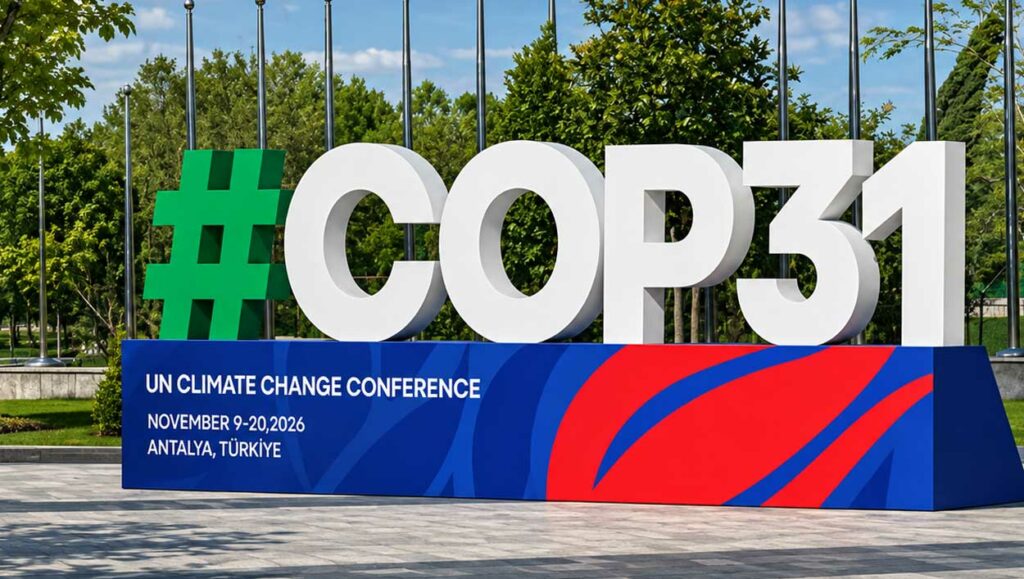
MedECC brought independent Mediterranean climate science to COP31 in Antalya, Türkiye (9-20 November 2026). Our scientists took part in five side events, presented a new report on climate, conflict, and migration at a press conference, and met policymakers throughout the Mediterranean Pavilion.
What was the Mediterranean Pavilion at COP31?
Coordinated by the Union for the Mediterranean (UfM), the Mediterranean Pavilion aimed to bring a united regional voice to the global climate conference. It also offered a platform to Mediterranean countries without a national pavilion. Over 12 days, it hosted more than 60 side events, around 300 speakers and some 1,000 attendees.
For MedECC, the Pavilion was both a stage and a meeting point. Piero Lionello and scientists from the network presented our reports and discussed the preparation of the Second Mediterranean Assessment Report (MAR2) with delegates between sessions.
Our five side events at a glance
13 November: UfM Climate Action Plan 2027-2028 launch, developed with its 43 Member States, on the COP31 Finance and Trade day. Adel Ben Youssef, MAR2 coordinating lead author on mitigation, brought the scientific perspective alongside Commissioner Dubravka Šuica and Jordan’s Minister of Environment
13 November: From dialogue to delivery (Pavilion of Morocco). The Plan was presented to delegations, financiers, the private sector, local authorities and youth, with a focus on the southern shore. Adel Ben Youssef spoke on the communities that deliver climate action.
13 November: Scaling up cooperation (Albania Pavilion). A panel on turning shared vulnerability into joint projects, drawing on the Western Balkans Green Agenda. Assem Abu Hatab (Nordic Africa Institute) stressed evidence-based decision-making.
16 November: Introducing MAR2. MedECC Coordinator Piero Lionello, IPCC Deputy Secretary Ermira Fida and MedECC authors explained why the Mediterranean needs its own assessment, rather than being split across IPCC regional chapters on Europe, Africa and Asia.
18 November: Environmental change, conflict and human migration. A roundtable accompanying the publication of our Expert Analysis, with coordinating lead authors Jan Wilkens and Eda Acara, alongside Piero Lionello.
Press conference: human mobility in a warming Mediterranean
On 16 November, MedECC presented the key findings of its report Environmental change, conflict and human migration in the Mediterranean Basin to the press.
What these five events tell us
Across finance, regional cooperation, assessment methodology and migration, three messages stand out:
- Priorities must become projects. Science grounds the financing conversation in evidence on mitigation and regional risk.
- The Mediterranean needs a regional approach. Climate challenges cross borders, and so must responses.
- The region needs its own assessment. MAR2 aims to offer an integrated Mediterranean view that complements global assessments, while MedECC’s latest report already shows how climate change interacts with vulnerability, conflict and mobility.
Science does not replace political decisions, it makes them better informed. That is MedECC’s role.
A Mediterranean track alongside global negotiations
COP31 closed on 22 November. Countries did not reach consensus on an overarching political decision, but adopted a series of decisions on specific items, including adaptation, climate finance and just transition.
In parallel, the Mediterranean advanced on its own track, notably through the Antalya Mediterranean Climate Dialogue. These national consultations give governments, researchers, businesses, civil society and youth a space to identify shared priorities. For a region warming faster than the global average, regional cooperation backed by independent science remains essential.
What’s next
The work continues right away. MedECC’s MAR2 authors will meet in Tangier, Morocco, from 29 November to 2 December 2026, to move forward with the developement of the Report, and starts building the Summary for Policymakers.